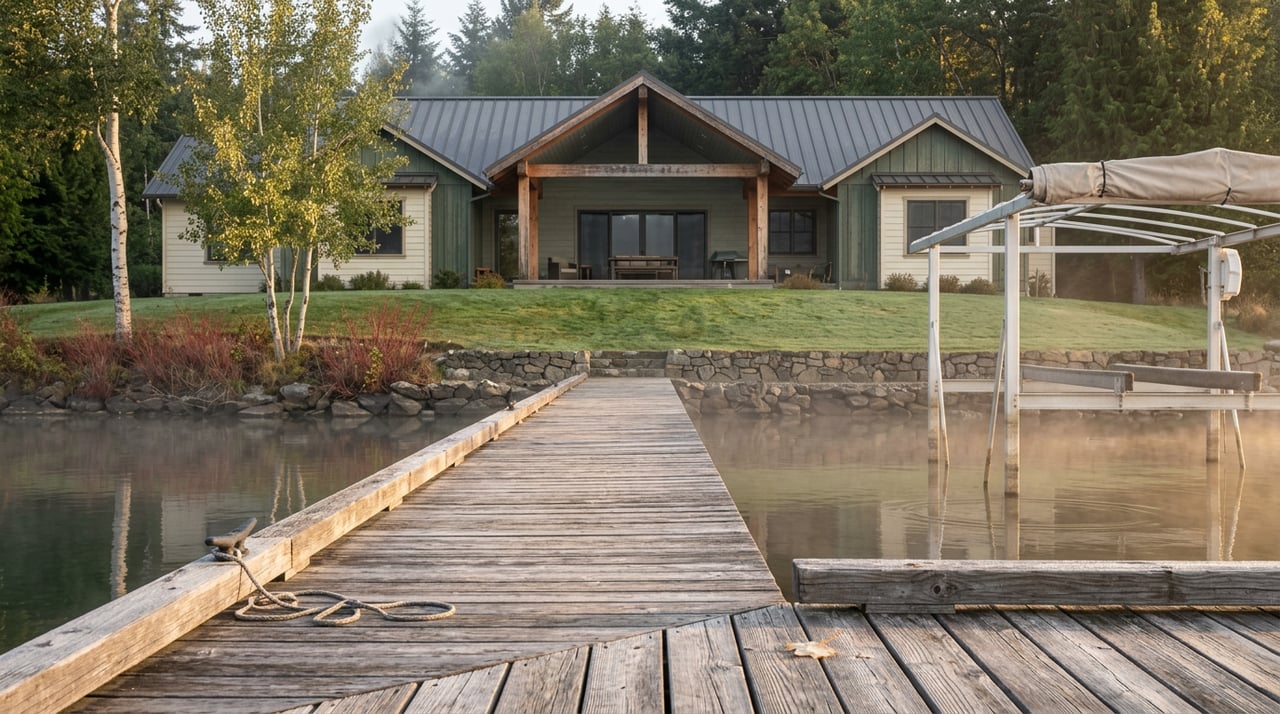
In early February, a Lakeside homeowner named Jeremy Newell watched a slurry of ice creep up the legs of his private dock and start to thicken. Most winters, the dock sits high and dry by then, well clear of the water as Flathead Lake drops toward its springtime low. This year it didn't drop. It rose. By the first week of February the lake sat more than five feet above where it normally sits at that point in the season, and Newell spent the month worried a hard freeze would tear the structure apart.
He wasn't alone. Tyler Cochran, who runs operations for a dock-building company in Polson, told the Daily Inter Lake he'd fielded more repair requests that winter than in any of the previous five years combined. Some docks lost a few planks. Others were destroyed outright. A homeowner south of Bigfork watched a windstorm tip his boat lift into the water and had to wade in to secure it before it drifted off.
None of this shows up in a listing photo. It shows up in a dock repair invoice, and it's the clearest evidence I can point to for a claim that changes how you should shop for property here: on Flathead Lake, "waterfront" is not a fixed feature of a parcel. It's a temporary condition, set by an operator managing water for reasons that have nothing to do with your dock.
The Lake Runs on Somebody Else's Schedule
Flathead Lake's water level is controlled by the SKQ Dam at its southern end, operated by Energy Keepers Inc., the tribally affiliated corporation that manages the facility under a 1965 agreement. Under its federal license, the dam manages the top ten feet of the lake, between 2,883 and 2,893 feet, which works out to about 1.2 million acre-feet of storage capacity. That ten-foot band is not decorative. It's the mechanism that decides whether your dock is usable, exposed, or wrecked in a given year, and the decisions that move the lake inside that band are made in response to conditions across the entire Columbia River Basin, not conditions on your shoreline.
Here's what that looked like in practice this past winter. A powerful atmospheric river dumped record precipitation across the Pacific Northwest in December 2025, and the Army Corps of Engineers directed dam operators throughout the basin to hold back as much water as they could to protect downstream areas near the Port of Vancouver from flooding. Energy Keepers CEO Brian Lipscomb told the Flathead Beacon the dam took in 238% of normal December precipitation, sending inflows soaring to more than 300% of normal. The lake filled to near full pool in the dead of winter, months ahead of its usual summer schedule, and that's exactly when the ice storms hit and started tearing up docks that were built for a lower, calmer lake.
Go back three years and the story flips entirely. In the summer of 2023, Flathead Lake dropped to its lowest recorded level in 23 years. Marinas in Polson pulled boats from the water on safety grounds. Docks that had operated fine for decades sat exposed on dry rock. The governor asked the federal government to intervene.
"Usually, the water is down low enough so docks wouldn't be affected."
That's Cochran again, describing what a normal winter looks like. The point isn't that 2025-2026 was unusual, or that 2023 was unusual. The point is that both are possible in the same decade on the same shoreline, and a listing that says "waterfront" tells you nothing about which version of the lake your dock will face this year.
What "Waterfront" Doesn't Tell You
Once you accept that the lake itself is a moving target, the marketing language on Lake County listings starts to look less like description and more like a spectrum you have to interrogate. A property near Finley Point with deeded frontage and a private dock faces a completely different exposure profile than a home in Mission Bay Preserve with shared access down to a community dock on Flathead Lake, or a lot on Rocky Point Road or in the Southlake Crest area advertising "lake views" from a hillside with no shoreline at all.
None of these are lesser properties. But they carry different risk, different maintenance cost, and different resale expectations, and the word "waterfront" gets stretched across all three in ways that flatten those differences for anyone comparing listings from out of state. A buyer relocating from a market where lake levels don't move ten feet in a season has no reason to know to ask the difference.
The Median Price Number That Isn't Telling You What You Think
There's a second place where Lake County's small transaction volume distorts the picture, and it shows up in price data rather than dock damage. Polson's residential market is thin enough that a handful of high-value closings, or their absence, can swing a reported median by a startling margin from one reporting window to the next. As of July 2026, one widely used portal put Polson's median list price at $689,000, down modestly from the prior month and roughly flat year over year. A separate tracker measuring closed sales through April 2026 showed the median sale price down nearly half from the year before.
Both numbers can be technically accurate and still mislead you, because they're measuring different things (list versus sold, different trailing windows) in a market where the transaction count is small enough that a single multimillion-dollar lakefront closing, or the lack of one, moves the needle hard. Local MLS data covering the trailing six months through mid-2026 puts it in more stable terms: 55 homes sold in Polson at a median of $550,000, with a median 83 days on market, out of 116 active listings ranging from roughly $222,900 to $10,995,000. That spread, from a couple hundred thousand dollars to eleven million, is the real story. A single median number can't represent a market with that range in it, and in Lake County it usually doesn't.
Fifteen Miles South, a Different Trade
For buyers who run the numbers on true lake frontage and decide the premium doesn't pencil, the Mission Valley south of Polson offers a genuine alternative rather than a consolation prize. Ronan, about fifteen miles down Highway 93, had 34 active residential listings as of mid-2026 ranging from about $215,000 to $2,950,000. Over the same trailing six months, 21 homes sold there at a median of $420,000, with a median 72 days on market, faster than Polson's 83.
| Polson | Ronan | |
|---|---|---|
| Active listings (mid-2026) | 116, from ~$222,900 to $10,995,000 | 34, from ~$215,000 to $2,950,000 |
| Homes sold, trailing 6 months | 55, median $550,000 | 21, median $420,000 |
| Median days on market | 83 | 72 |
What that $130,000 median gap buys is a different kind of property, not a lesser one. Ronan sits at the heart of the Mission Valley, with sweeping views of the Mission Mountains rather than the lake, working farmland instead of shoreline, and buyers there are typically looking at acreage along corridors like Round Butte Road or Snyder Hill Lane rather than dock rights. The Ninepipe National Wildlife Refuge sits between the two towns, drawing buyers who want birdwatching and open wetlands as part of their daily view. It's a fair trade for someone who wants space and mountain scenery more than they want a boat slip, and the faster time on market suggests buyers who know what they want there aren't waiting as long to close on it.
Before You Write an Offer on "Waterfront"
If you're comparing Lake County listings and the word waterfront appears in more than one of them, a few questions will tell you more than the listing photos will:
- Is the frontage deeded and private, or is it shared access through an HOA or community dock, as in developments like Mission Bay Preserve?
- What's the dock's repair history, and has the current owner filed any insurance claims tied to ice or storm damage in the past three winters?
- Where does the parcel sit relative to the SKQ Dam's 2,883 to 2,893 foot operating band, and has the owner seen the shoreline exposed during a low-water year like 2023 or battered during a high-water winter like 2025-2026?
- Is the "view" priced into the listing actually a lake view, or a view of the Mission Mountains from a hillside lot with no water access at all?
None of these questions have a wrong answer. A shared-access property with a strong HOA-maintained dock can be a perfectly sound purchase, and so can a mountain-view lot with no lake access whatsoever. The problem isn't the property type. It's buying one type while believing you're buying another, in a market where a single word is asked to describe a shoreline that moves ten feet a year.
A Quick Word on What Comes Next
None of this is a reason to avoid Flathead Lake. It's a reason to ask sharper questions before you fall for a listing photo taken on the one calm afternoon a year the lake sits exactly where the marketing wants it to. Whether you're comparing a Finley Point lakefront against a Mission Bay Preserve access lot, or weighing true waterfront against a Ronan property with Mission Mountain views, the numbers only make sense once someone walks you through what they're actually measuring.
If you want that kind of read on a specific property or neighborhood in Lake County, get in touch with Ashley Inglis for a personalized market consultation.
A Few Common Questions
Does a property's exposure to lake level swings affect its insurability? Insurance considerations vary by carrier and by the specific shoreline and dock structure involved, and they're worth raising directly with a local agent before you write an offer, especially on a property with a documented history of storm or ice damage.
Is Ronan close enough to still get lake access without paying for frontage? Ronan itself doesn't border Flathead Lake, but it sits about fifteen miles from Polson on Highway 93, close enough for regular day trips to the water without the frontage premium, which is part of why buyers who prioritize acreage and mountain views over a private dock look there.